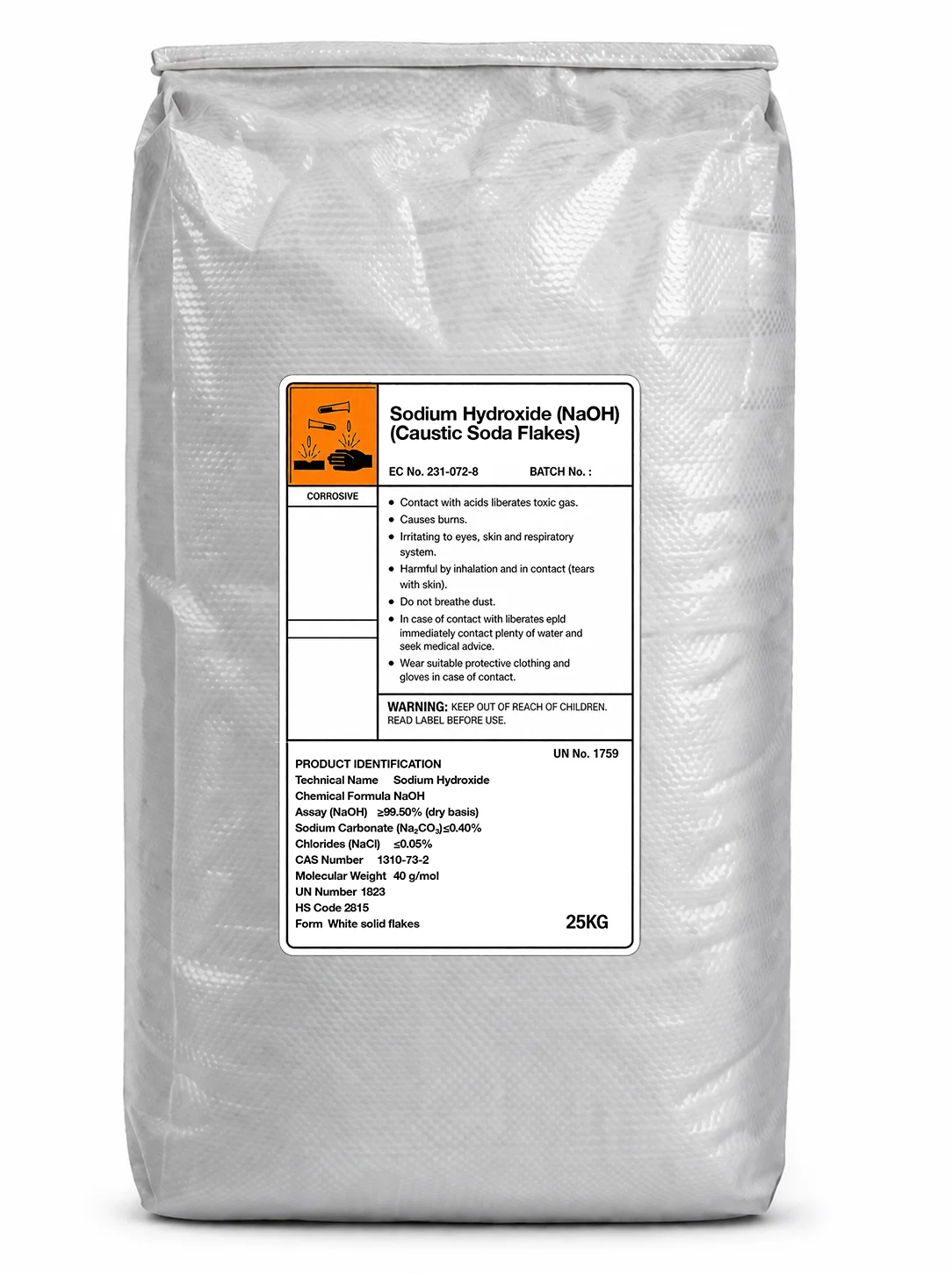
Caustic Soda (Sodium Hydroxide) 25Kg
Caustic Soda (Flakes) for Groundwater Treatment
(Sodium Hydroxide NaOH/Lye orCaustic)
Product Overview
Caustic soda flakes (sodium hydroxide, NaOH) represent one of the most efficient and versatile alkalis available for raw groundwater treatment, delivering powerful pH adjustment and significant oxidation enhancement capabilities in a convenient solid form. As a white, deliquescent material with over 99% purity, these flakes provide a concentrated source of hydroxide ions that rapidly neutralises acidity, elevates pH, and creates optimal conditions for subsequent treatment processes.
Role in pH Control and Oxidation Enhancement
In groundwater treatment, caustic soda serves as the alkali of choice for raising pH and establishing stable alkaline conditions throughout the treatment train. When added to water, it dissociates completely to release hydroxide ions, which neutralise free hydrogen ions and convert carbon dioxide to bicarbonate and carbonate species.
This pH elevation dramatically enhances oxidation kinetics, enabling oxidants such as chlorine, ozone, and permanganate to perform more effectively against dissolved iron, manganese, and organic contaminants. The chemical reactions involved in this process are well-documented, including the neutralisation of carbonic acid and the precipitation of hardness-causing minerals such as calcium and magnesium.
Key Features and Benefits
Caustic soda flakes offer superior pH correction for acidic groundwaters, rapidly lifting pH into the optimal range for coagulation, flocculation, and disinfection while providing robust alkalinity buffering to resist pH fluctuations. The elevated pH conditions significantly enhance the oxidation and precipitation of dissolved iron (Fe²⁺ to Fe³⁺) and manganese (Mn²⁺ to Mn⁴⁺), facilitating their removal through subsequent filtration.
Furthermore, caustic soda softens water by precipitating calcium carbonate and magnesium hydroxide, reduces the corrosive aggressiveness of low-alkalinity groundwater, and protects distribution infrastructure while improving the efficacy of other treatment chemicals. The flake form offers advantages in handling, storage, and transportation compared to liquid caustic, with a lower freezing risk in colder climates.
Dilution Ratios and Preparation
Preparing a caustic soda solution requires strict attention to safety due to the highly exothermic reaction that occurs when the flakes dissolve in water. A common dilution ratio is 500 grams of caustic soda flakes to 2 litres of cold water, producing approximately a 30% sodium hydroxide solution. Always add the flakes slowly to cold water in a stainless steel or heat-resistant container, never add water to the flakes, as this can cause violent boiling and dangerous splashing. The mixture becomes extremely hot and must be allowed to cool completely before use.
For commercial water treatment applications, typical dosing concentrations range from 2 to 100 mg/L as caustic soda, though higher concentrations may be required for poorer quality waters. A suitable concentration for neutralising wastewater is approximately 50 ppm, which translates to about 35 kg per day for a 700 m³ treatment volume. For general cleaning applications, a dilution of 4 to 10 millilitres of the prepared 30% solution per litre of warm water is effective.
Additional Applications Beyond Water Treatment
Beyond groundwater pH control and oxidation enhancement, caustic soda flakes serve numerous complementary functions in treatment facilities and industrial processes. They are essential for cleaning and descaling pipelines, vessels, and equipment by dissolving organic deposits, grease, and scale accumulation. In the broader industrial landscape, caustic soda is a fundamental reagent in the production of soaps and detergents through saponification, in the pulp and paper industry for delignification, in textile manufacturing for mercerisation of cotton, in petroleum refining for acid removal, and in the food industry for purification of fats and oils.
Operating Considerations and Storage
Caustic soda flakes are highly hygroscopic, readily absorbing moisture and carbon dioxide from the air, so containers must be kept tightly sealed. Dosing systems should be constructed from corrosion-resistant materials such as stainless steel, polyvinyl chloride, polypropylene, or fibreglass-reinforced plastic.
Careful monitoring and control are essential when adding caustic soda to poorly buffered waters, as pH response can be difficult to manage. In cold climates, liquid caustic solutions of certain concentrations may freeze, so dilution or heating of storage facilities may be necessary.
Excessively high pH levels should be avoided to prevent scaling and ensure compliance with drinking water quality standards. The sodium contributed to treated water from caustic soda dosing is generally insignificant for health considerations.
| SKU | CSS-B-25Kg-0141 |
| Variant SKU | CSS-B-25Kg-0141-default |
| Brand | CWT |
| Condition | New |
| Weight | 25.00 kg |
| Stock | In Stock |
Reviews coming soon.