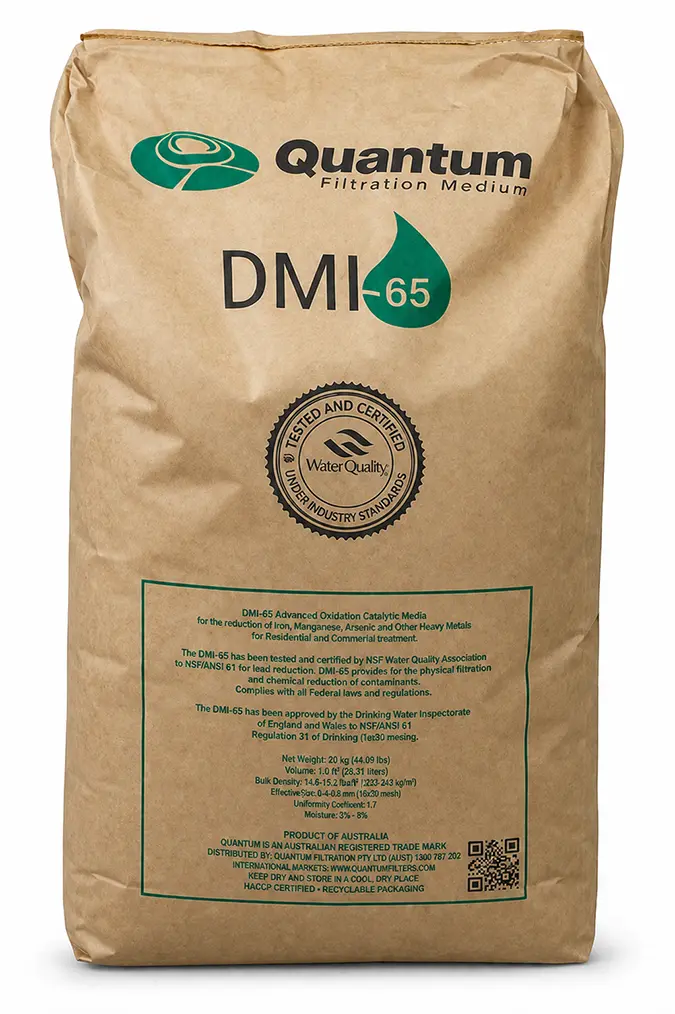
DMI-65® Media 21Kg
Effective pH range: 5.8 - 8.6.
Operates via the continuous injection of low residual levels of sodium hypochlorite (0.1 to 0.3 ppm).
DMI-65® Filtration Media
Infusion Technology
- Powerful oxidizing agents are chemically infused to the microporous sub-structure of the matrix material. Infusion Technology increases the catalytic surface and gives DMI-65 the highest oxidation rate and load capacity of any other catalytic media.
- Infusion Technology allows for very small attrition loss and displays no decaying effect or loss or catalysis for up to 5 – 10 years of continuous performance.
- DMI-65 protects and pre-treats all other water treatment systems from iron and manganese bio-fouling, effectively longer filter run times, and with the benefit of reduced oxidant demand andbecause DMI-65 Infusion Technology requires no chemical regeneration.
Bed Depth and Water Velocity
Filter media depth needed increases with the decrease in the amount of residual iron and manganese allowed in the filtered water. Maximum bed depth could be just over 1 meter and relates also to the flow capacity of the system and effective height of available filters.
Water velocity through the filter should be selected in accordance with the usage of the filtered water, size of water treatment plant, water quality and other factors.
For large drinking water treatment plants, the depth of the bed should be selected towards the maximum and the water velocity around 5 m3/m2/hour in any case not more than 10 m3/m2 /hour.
This maximizes performance in removing iron and manganese, reduces the frequency of backwashing, reduces power consumption because average pressure drop is lower, and could provide redundancy in case one of the filters is out of order and higher flow rate must be put through the remaining filters.
The upper limit of velocity, up to 30 m3/m2/hour should be used for small bed depth and larger allowed amount of residual iron and manganese in the filtered water.
Technical Datasheet for DMI-65®: Manganese
0.5ppm – 1ppm = LV 8 – 10m3/m2/hour
1ppm – 2ppm = LV 5 – 7m3/m2/hour
Greater than 2ppm would require the same technique above by dosing the holding tank with chlorine and allowing about 10 to 15 minutes detention time to oxidise the manganese, the remaining manganese that has not oxidised will be polished out the by the DMI-65.
All at a pH of as close pH8 as possible.
Technical Datasheet for DMI-65®: Iron & Manganese
Typically iron and manganese exist together in ground water sources at low levels of under
2ppm and 1ppm respectively. In these sorts of conditions I recommend the following:
Iron 2ppm – Manganese 1ppm = LV 8 – 9m3/m2/hour as close to pH 7.5 – 8 as possible.
If the Iron concentration is higher than 2ppm and has some manganese, than slow LV down to between perhaps 7 – 8m3/m2 hour and maintain pH as close to 7.5 – 8 as possible.
If the manganese concentration is higher than 1ppm and there is considerable iron say 2 – 3ppm also, than the water matrix is very dependent on a slow LV of 5 – 7m3/m2/hour and pH 8 is highly necessary.
For any water matrix that contains high iron (considered to be above 15ppm) and high manganese (considered this to be 3ppm) than the same method of pre-treatment is recommended.
Technical Datasheet for DMI-65® Disclaimer: The information and recommendations provided are true and based on accurate case studies and professional experience. The Information and Performance guides are offered in good faith and without warranty. Quantum Filtration Medium Pty Ltd recommends DMI-65 users conduct pilot trials and demonstrate a point of proof for all commercial applications. The DMI-65 is guaranteed to be of the highest quality as described by the packaging, literature and as certified by the Water Quality Association of the USA to NSF/ANSI 61 gold standards.
| SKU | DMI-B-21KG-0159 |
| Variant SKU | DMI-B-21KG-0159-DEFAULT |
| Brand | CWT |
| Condition | New |
| Stock | In Stock |
Reviews coming soon.