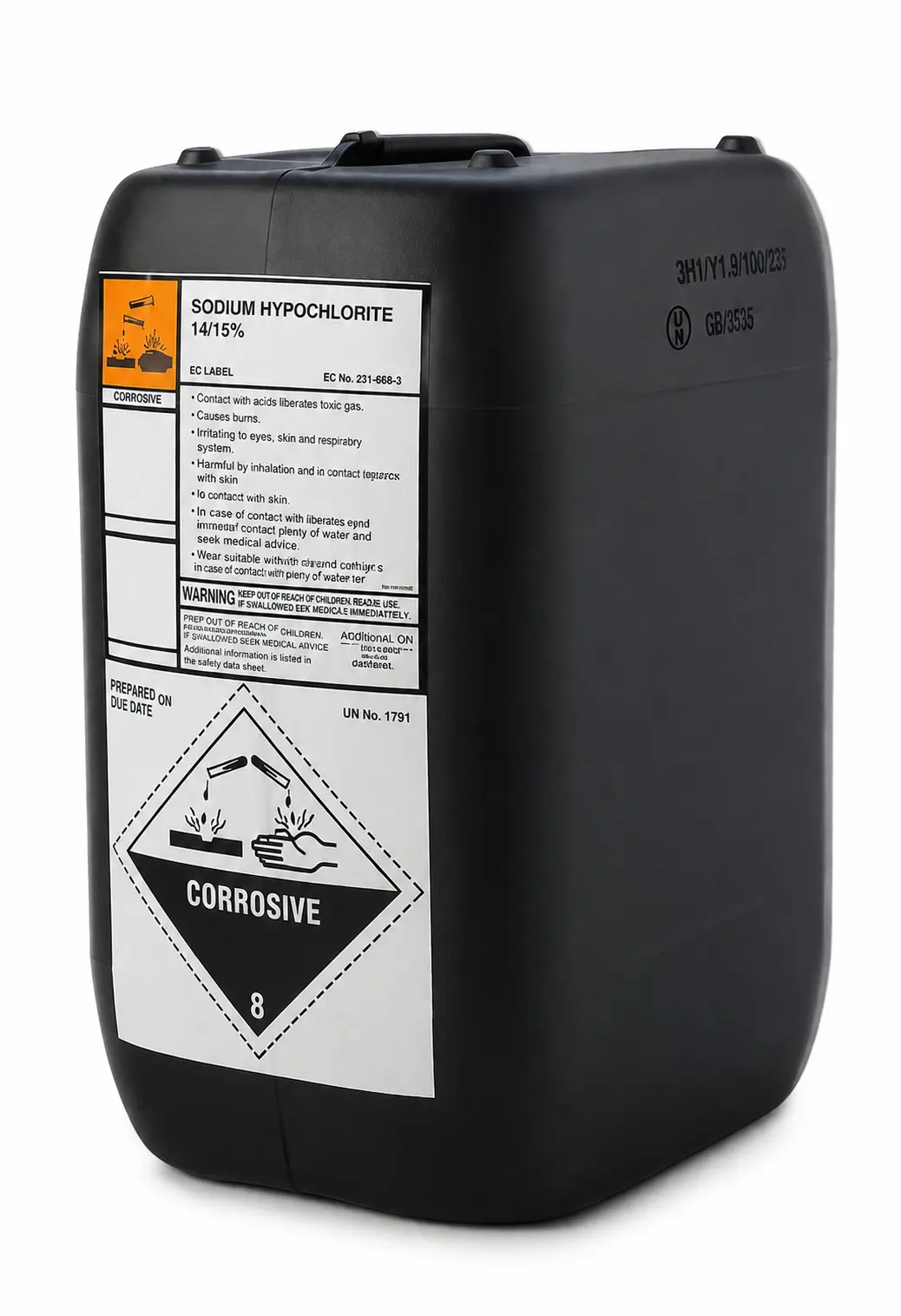
Sodium Hypochlorite 25L
Sodium Hypochlorite (NaOCl) for Groundwater Treatment
Product Overview
Sodium hypochlorite—chemically designated as NaOCl—is the most widely used and trusted liquid oxidant and disinfectant for raw groundwater treatment, delivering powerful oxidation capabilities alongside exceptional antibacterial and algicidal properties in a convenient, stable aqueous solution. As a clear to slightly yellowish liquid with a characteristic chlorine odour, sodium hypochlorite serves as the workhorse of modern water treatment, effectively oxidising dissolved contaminants, neutralising pathogenic microorganisms, and controlling nuisance algae growth throughout the treatment and distribution system.
How It Works
When sodium hypochlorite is introduced to groundwater, it rapidly dissociates into sodium ions and hypochlorite ions (OCl⁻), which establish a dynamic equilibrium with hypochlorous acid (HOCl) depending on the water's pH. This combined pool of free chlorine—comprising both HOCl and OCl⁻—is the active oxidising agent that drives treatment performance.
Hypochlorous acid, being the more potent and fast-acting species, penetrates microbial cell walls to oxidise essential enzymes and genetic material, achieving rapid bacterial inactivation. Simultaneously, the oxidative power of sodium hypochlorite attacks dissolved iron (Fe²⁺) and manganese (Mn²⁺), converting them into insoluble precipitates that are readily removed by sedimentation and filtration.
The same oxidative mechanism breaks down hydrogen sulphide, oxidises organic matter, and disrupts the metabolic processes of algae, effectively controlling blooms and biofilm formation in raw water sources and storage reservoirs.
Key Features and Benefits
Sodium hypochlorite provides powerful broad-spectrum disinfection against bacteria, viruses, and protozoan cysts, ensuring microbiologically safe drinking water. Its strong oxidative capacity effectively removes iron, manganese, hydrogen sulphide, and colour-causing organic compounds from raw groundwater.
The product offers residual protection throughout the distribution network, maintaining a measurable free chlorine residual that continues to safeguard water quality from the treatment plant to the consumer's tap. Sodium hypochlorite is supplied as a stable liquid solution, eliminating the handling hazards associated with chlorine gas while providing consistent and accurate dosing.
It is highly effective against algae growth in raw water reservoirs, storage tanks, and treatment basins, preventing taste and odour issues while reducing the organic loading on downstream processes. Additionally, it aids in breaking down biofilms in pipelines and equipment, improving overall system hygiene and hydraulic performance.
Dilution Ratios and Preparation
Sodium hypochlorite is commercially available in various strengths, typically ranging from 10 to 15 percent available chlorine for industrial water treatment applications, with household bleach commonly at 3 to 6 percent.
Groundwater Treatment: It is generally applied directly from bulk storage using precision chemical metering pumps, though further dilution may be necessary for smaller systems or specific applications.
A common commercial dilution ratio involves preparing a 1 percent stock solution by mixing 1 part of 10 to 15 percent sodium hypochlorite with 9 to 14 parts of clean, soft water—always adding the hypochlorite to water and never water to the chemical, and ensuring the water is cold to minimise off-gassing.
Continuous Groundwater Treatment: Typical dosing rates range from 0.5 to 5 milligrams per litre of free chlorine, adjusted according to raw water quality and contact time requirements. For oxidising iron and manganese, doses of 0.5 to 2.0 milligrams of chlorine per milligram of iron or manganese are generally effective, though field testing is essential to determine optimal rates.
General Pipeline Disinfection and Shock Chlorination: Higher concentrations of 25 to 100 milligrams per litre may be applied with extended contact times, followed by thorough flushing to reduce residual chlorine to acceptable drinking water levels.
Algae Control: In raw water reservoirs, initial slug doses of 1 to 3 milligrams per litre may be applied, with ongoing maintenance dosing of 0.2 to 0.5 milligrams per litre to prevent regrowth.
Additional Applications Beyond Groundwater Treatment
Beyond its primary role in water treatment, sodium hypochlorite serves a vast array of industrial and domestic applications. It is the active ingredient in household liquid bleach, widely used for laundry whitening and general surface disinfection. In the food and beverage industry, it is employed for sanitizing equipment, food contact surfaces, and processing water.
The healthcare sector relies on sodium hypochlorite for disinfecting medical instruments and surfaces, and it is a key component in wound irrigation solutions at dilute concentrations. Municipal wastewater treatment facilities utilize sodium hypochlorite for effluent disinfection before discharge into receiving waters.
In swimming pool maintenance, it provides continuous sanitization, controlling bacterial growth and algae proliferation. Industrial cooling water systems benefit from sodium hypochlorite dosing to control microbial fouling and biofilm accumulation on heat exchange surfaces. The pulp and paper industry uses it as a bleaching agent, while textile manufacturers apply it for fabric whitening and stain removal.
Operating Considerations and Storage
- Sodium hypochlorite is a strong oxidiser and must be handled with appropriate personal protective equipment including chemical-resistant gloves, goggles, and protective clothing.
- The product is sensitive to heat, light, and heavy metal contaminants, which accelerate its natural decomposition into sodium chloride and oxygen, reducing available chlorine strength.
- Storage temperatures should ideally be maintained below 25°C, with tanks kept in cool, shaded areas protected from direct sunlight.
- Sodium hypochlorite decomposes more rapidly in acidic conditions, so storage tanks should be constructed from compatible materials such as high-density polyethylene, fibre-reinforced plastic, or chlorinated polyvinyl chloride, and should be vented to prevent pressure build-up from oxygen off-gassing.
- Reaction with acids, ammonia, or organic materials can produce hazardous gases, including chlorine gas and chloramines, so strict separation from incompatible chemicals is essential.
- Regular strength testing is recommended to verify available chlorine concentration, as decomposition is inevitable over time.
- When blending with raw groundwater, adequate mixing and sufficient contact time are essential for effective disinfection and oxidation, with a minimum contact time of 30 minutes at peak flow recommended before the water enters the distribution system.
Conclusion
Sodium hypochlorite (NaOCl) remains the global standard for groundwater oxidation and disinfection—a powerful, reliable, and cost-effective solution trusted by water utilities worldwide. Its unparalleled ability to deliver simultaneous microbial inactivation, contaminant oxidation, and residual protection makes it indispensable for treating raw groundwater of varying quality.
Whether oxidising troublesome metals, eradicating bacterial pathogens, controlling algal blooms, or safeguarding distribution networks, sodium hypochlorite delivers the performance, flexibility, and safety that modern water treatment demands.
| SKU | SHL-B-25Kg-0144 |
| Variant SKU | SHL-B-25Kg-0144-DEFAULT |
| Brand | CWT |
| Condition | New |
| Weight | 25.00 kg |
| Stock | In Stock |
Reviews coming soon.