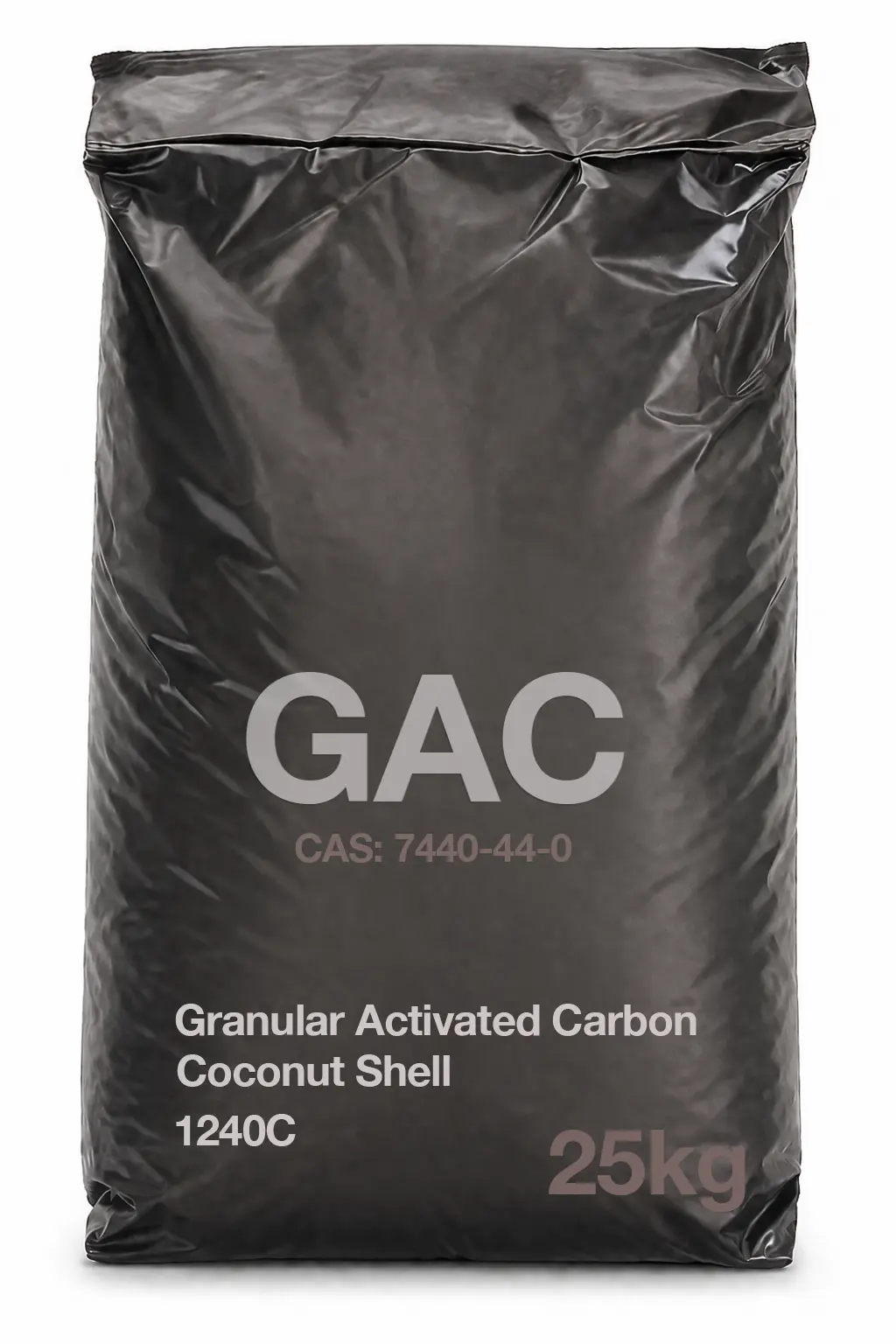
Granular Activated Carbon Coconut Shell 25Kg
Granular Activated Carbon (GAC), Coconut Shell, 25 kg
High-grade coconut shell activated carbon for carbon filters: removes chlorine, reduces VOCs, pesticides, hydrogen sulphide, colour, and taste and odour compounds.
Overview
Steam-activated coconut shell carbon: a naturally fine pore structure, harder than coal- or wood-based carbon, with low ash and a high density of adsorption sites – the preferred carbon for borehole, groundwater and drinking water filters.
What carbon filtration does for your water
Activated carbon works by adsorption: dissolved contaminants stick to the surface of the carbon as water flows through it. Each gram of coconut shell carbon has roughly 1,000–1,200 m² of internal surface – the area of several tennis courts – packed into millions of microscopic pores that trap molecules far too small for any ordinary filter to catch.
- Removes chlorine taste and smell: carbon converts free chlorine to harmless chloride. Essential after chlorine or sodium hypochlorite dosing for drinking water and irrigation, and it protects downstream iron removal media and RO membranes that chlorine would damage.
- Reduces VOCs (volatile organic compounds) – see below.
- Reduces pesticide and herbicide residues that can reach groundwater from farmland, gardens and golf courses.
- Removes hydrogen sulphide: the rotten-egg smell common in borehole water.
- Improves taste and odour: adsorbs the earthy, musty and swampy compounds (such as geosmin and MIB) behind “off” tasting water.
- Reduces colour: removes the tea-coloured tannins and humic substances common in Cape groundwater and wellpoint water.
- Reduces disinfection by-products: such as trihalomethanes (THMs), which can form when chlorine reacts with organic matter in the water.
- Protects the rest of your system: by removing chlorine, H2S and organic foulants first, it extends the life of iron removal media, softeners, RO membranes and UV lamps.
VOCs explained
Volatile organic compounds are carbon-based chemicals that evaporate easily. They are usually invisible and often tasteless at the levels found in water, so a lab test is the only way to know they are there. Common examples are:
- Fuel components – benzene, toluene, ethylbenzene and xylene (“BTEX”) from leaking underground fuel tanks, service stations, workshops and spills.
- Industrial solvents and degreasers – such as trichloroethylene (TCE) and tetrachloroethylene (PCE) from dry cleaners, metal works and factories.
- Agricultural chemicals – some fumigants and pesticide ingredients behave as VOCs.
- Disinfection by-products – chloroform and other THMs formed when water is chlorinated.
Groundwater moves slowly and is not exposed to air, so once VOCs reach an aquifer they can stay there for years and travel well beyond the original spill. Long-term exposure to some VOCs is linked to health risks, and because they evaporate they can also be breathed in from shower steam – not only swallowed. Activated carbon is one of the most widely used and effective treatments for reducing VOCs in drinking water.
What carbon does NOT remove
- Bacteria and viruses: carbon does not disinfect – and bacteria can grow on the carbon itself. Where water is used for drinking, follow it with UV disinfection.
- Dissolved salts and minerals: hardness, TDS, chloride, sulphate, nitrate and fluoride pass through. These need softening, ion exchange or reverse osmosis.
- Dissolved iron and manganese: these need an oxidation stage (chemical dosing or ozone) and a filter such as the NanoJet™ STANDARD Iron & Sludge Removal Kit first.
- Silt and cloudiness: heavy suspended solids should be filtered out beforehand so they don’t clog the carbon.
Getting the most from your carbon filter
- Contact time matters: the longer the water spends in the carbon bed, the more it removes. We size the vessel to your flow rate so the water passes slowly enough.
- Backwashing keeps the bed loose and clear of trapped particles, but it does not restore the carbon’s adsorption capacity.
- Replace the carbon when its pores are full – typically when chlorine taste or odour starts coming back. How long that takes depends on your water; your lab results tell us what to expect.
- Where it goes in the system: after iron and manganese removal and any chlorine dosing, and before RO or UV.
Typical specifications
- Raw material: 100% coconut shell
- Iodine number: 900–1,100 mg/g
- Surface area (BET): 1,000–1,200 m²/g
- Ash content: under 3%
- Hardness number: 98% or higher
- Moisture (as packed): under 5%
- Bulk density: 0.45–0.55 g/mL
- pH (aqueous extract): 7–9
How much you need
For our FRP carbon filters: 30 L vessel – 1 bag, 50 L – 2 bags, 80 L – 3 bags, 120 L – 4 bags, 150 L – 6 bags.
Setting up
- Place a supporting gravel layer at the bottom of the vessel to cover the bottom distributor before adding the carbon.
- Soak dry carbon in water inside the vessel for 12–24 hours before the first backwash, to release trapped air and fully wet the granules.
- Backwash well before first use to rinse out carbon fines (the first water will run black).
| SKU | GAC-B-8x30mesh-0173 |
| Variant SKU | GAC-B-8x30mesh-0173-DEFAULT |
| Brand | CWT |
| Condition | New |
| Weight | 25.00 kg |
| Dimensions | 39.0 × 60.0 × 13.0 cm |
| Stock | In Stock |
Reviews coming soon.